


Taylor’s Ferry & the powder magazine
General Nathaniel Greene wrote Thomas Jefferson a letter, requesting the State to “immediately lay up a Magazine of 10,000 barrels of Flour and 5,000 Barrels of Beef and Pork, at Taylor’s Ferry and upwards upon the Roanoke.” The General asked for enough to get them through the winter, including: blankets, arms, 3,000 head of cattle driven to camp, salted provisions, brandy, 100 wagons with 4 horses per wagon and 5,000 pounds of money for various expenses. Carpenters, blacksmiths, wheel wrights, saddlers, boat builders and ship wrights were requested. General Greene considered the supplies he requested were “absolutely necessary to put the Army in a Condition to oppose the enemy.” **
The “Race to the Dan” took place several months later, in February 1781. Major General Nathaniel Greene was the commander of the southern area of the war. The strategy was for the Continental Army to retreat to an area they could safely rest and get fresh supplies. Major General Greene led about half the group further inland, aiming for Dixon Ferry, but ended up crossing at Boyd’s Ferry & Irvin’s Ferry about 3 miles west, both in Halifax County, Virginia. The men quickly covered over 200 miles of rough terrain, with poor shoes & clothing during the winter. Brigidier General Daniel Morgan led the other part of the southern army to distract British officers Tarleton & Cornwallis on his way home. This article from an Army historian says General Greene wrote about 770 letters in 95 days for intelligence, and did innovative things like using boats with wheels during the “Race to the Dan”. By the time Lord Cornwallis reached the Dan River, the last boat was removed and the water was too dangerous to cross. The British Army was stranded south of the river with most of General Cornwallis’s supplies burned in an effort to travel faster to the Dan. The British Army retreated to camp at Hillsborough, North Carolina.
Continental baggage & supplies crossed at Taylor’s Ferry, before the troops crossed the Dan River. This article (below) appeared in the newspaper 5 May 1781 in England, but the events would have taken place February 1781.

Major General Johann Kalb wrote a letter to the Board of War. In the post script he added: “I shall send back and leave at Taylor’s Ferry my two Howitzers-with ammunition thereto belonging under a Guard of Virginia State Artillery.” **
British Lieutenant Colonel Bonastre Tarleton was ordered by Lord Cornwallis to destroy ammunition and supplies in the Southside of Virginia. His army burned and destroyed many provisions, but the powder magazine near Taylor’s Ferry, including Major General Kalb’s Howitzers remained safe and secure.
A newspaper in Leicester, England reported that General Greene needed shoes and other supplies and could only meet Colonel Gunby at Taylor’s Ferry because he was being harassed by Lord Cornwallis. The incident reported happened in February. This same news brief was copied in multiple newspapers in England, Maryland and Pennsylvania.

Leicester Journal, and Midland Counties General Advertiser; Leicester, Leicestershire, England; Sat, May 19, 1781. Page 1
This report was printed in a Philadelphia newspaper, then copied in an Irish newspaper. We learn from this article that the Race to the Dan, with supplies from Taylor’s Ferry, rejuvenated the Continental Army and historians recognize this as a turning point in the war.

The Public Register, or, Freeman’s Journal; Dublin, Dublin, Ireland; Sat, Feb 3, 1781.Page 4
Horatio Gates wrote a letter to Thomas Jefferson about moving supplies to and from Taylor’s Ferry. **
My great….grandfather, William B. Jones, mentioned Taylor’s Ferry in a deposition he gave for a Revolutionary War pension. William Jones said his brother John Jones and John Carroll went with several others to repair the two cable lines on the ferry across the Roanoke River. William said the area by Taylor’s ferry was a headquarters. William and others took horses to Taylor’s Ferry to assist the men on their march to Taylor’s Ferry. On their return trip, a press gang tried to take their horses at the bridge crossing Allen’s Creek. The gang took up boards out of the middle of the bridge & surrounded the bridge. William’s horse got afraid and leaped over the men and the gap. This story is how William remembered John Carroll was a soldier in the war, about 73 years after it occurred. (William Jones in the community tree.)

May 1781: The Militia at Taylor’s Ferry
From Library of Virginia: “Most Virginians serving in the war did so as part of the county militia. All “free male persons, hired servants, and apprentices” (apparently restricted beginning in 1777 to free white and “mulatto” males) aged 16 to 50 were considered part of the militia, unless exempted. Militiamen could be called for tours of duty up to three months, serving mostly within Virginia but also in the Carolinas. Many served more than one tour of duty during the war. Unfortunately, few records of militia service exist.”
Thomas Jefferson wrote a letter to Lafayette about the Virginia militia saying 1/10th of the Army was sent to rendezvous at Richmond, Prince Edward County Courthouse and Taylor’s Ferry. Jefferson, Governor of Virginia at this time, ordered 1/4 of the militia from Henry, Pittsylvania, Bedford, Buckingham, Prince Edward, Halifax and Charlotte to be sent to Taylor’s Ferry or Prince Edward Courthouse, which is about 60 miles north of the ferry. Jefferson concluded the letter with, “Counties required to send every man whom they could arm immediately to Taylor’s Ferry, Prince Edward Courthouse, or Richmond to aid in the present crises: Lunenburg, Mecklenburg, Greensville, Brunswick, Amelia, Cumberland, Louisa, Caroline, Fluvanna, Albemarle, Orange, Spotsylvania, Hanover, King William, King & Queen, and Essex.” **
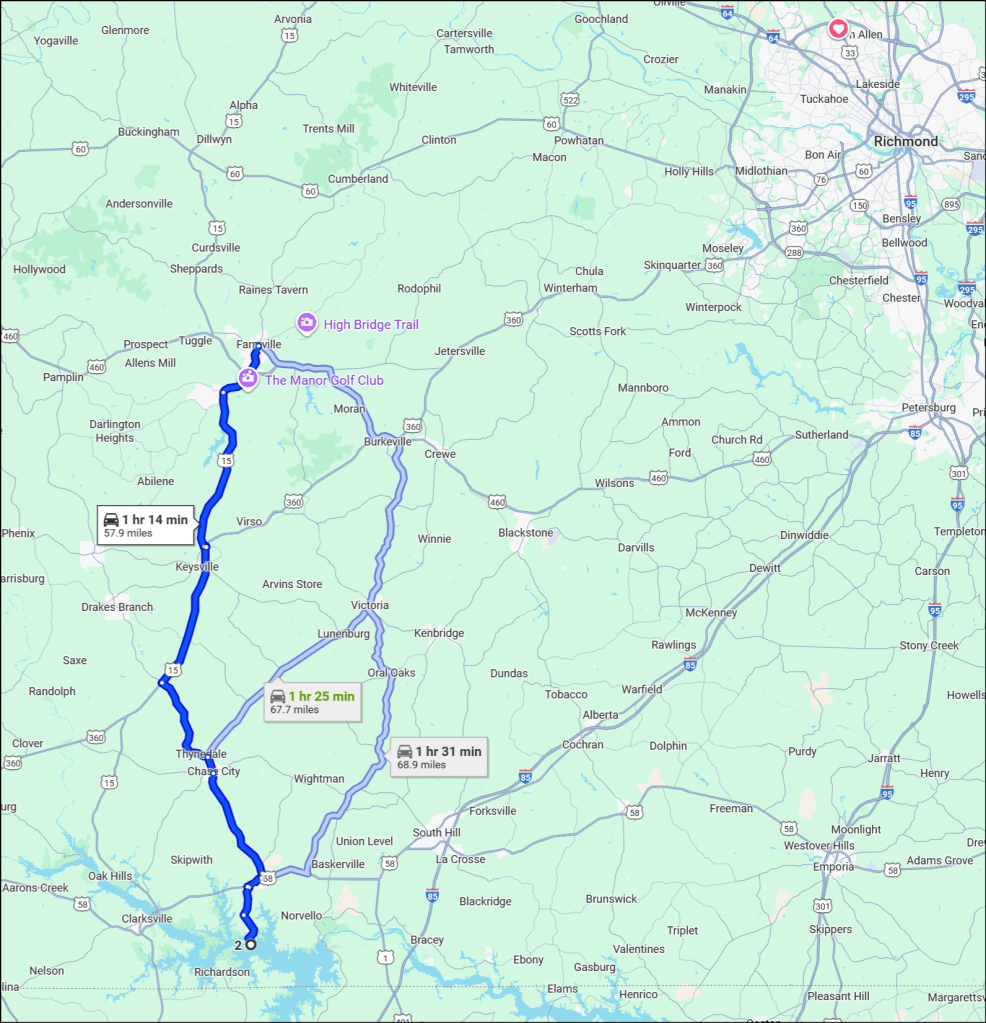
Map showing present day routes to 1) Prince Edward Courthouse, 2) Taylor’s Ferry, and 3) Richmond, upper right corner of this map.
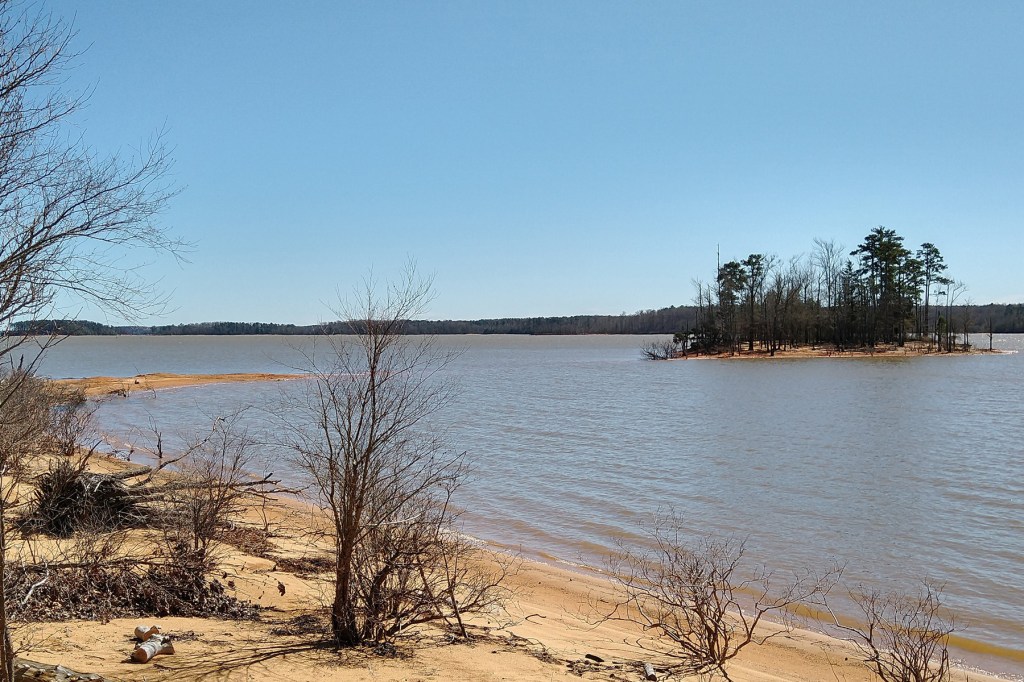
Estimated area of Taylor’s Ferry, Eagle Point. March 2023
Related
- Map that shows Race to the Dan, including Taylor’s Ferry marked
- Historic marker for Taylor’s Ferry
- The American Revolution in NC (note: the Mecklenburg on this page refers to North Carolina, not Virginia)
- Association of the United States Army-Race to the Dan
- Halifax County, VA Race to the Dan
Where did Field Jefferson live?
Field Jefferson was President Thomas Jefferson’s uncle. This newspaper article (below) published in Leicester England talks about crossing the Roanoke River at both Taylor’s Ferry & Jefferson Ferry. The only place I could find anything about a ferry called “Jefferson” was in the court books of Lunenburg (pre-1765) and Mecklenburg Counties Virginia. The court books said Field Jefferson owned the ferry.

“The Old Free State, A contribution to the history of Lunenburg County and Southside Virginia”, Book II, by Landon C. Bell, c.1927. Page 292 stated Field Jefferson lived “near Clarksville, about where the Dan and Staunton form the Roanoke. He called his farm Occoneechee.” This was repeated in a WPA survey and other writings which share the history of the area. Monticello.org says Field Jefferson named his plantation “Occoneechee Farm”, which was the name of the local tribe. Field post office & Occoneechee State Park are near Clarksville, but Field Jefferson’s brother marked Field Jefferson’s plantation & ferry 17 miles away from Clarksville, by river route.
President Thomas Jefferson’s father, Peter Jefferson, was a map maker, known for the 1755 Fry-Jefferson map. Other than rivers, only three things were labeled in the area of present day Mecklenburg County: the Lunenburg Courthouse, Occoneechee Island and “Jefferson”, about half way between Allen Creek & Miles Creek. Two years before the Fry-Jefferson map, the Lunenburg Court of Oct 1753 authorized Field Jefferson to run a ferry over the Roanoke River where he lived. Field Jefferson was a well known gentleman, magistrate and vestryman in Lunenburg County. (Pre-Mecklenburg County days). It’s absolutely certain that the Field Jefferson mentioned in the Lunenburg Court records was the brother of Peter Jefferson, the mapmaker.

A brief title history of the ferry: from Jefferson’s to Alexander’s Ferry
- 15 Jul 1760 Field Jefferson had land patent that was 2,200 acres, on the north & south of the river. Bordering the property of Hutchins Burton.
- 28 Sep 1762 Field Jefferson gifted land on the North side of the Roanoke River, where Field lived, except for 4 acres at the ferry landing. Field purchased the land from Francis Howard, deceased, on 15 Oct 1746, adjoining the land of Hutchins Burton, George Jefferson & Field Jefferson’s land. (Lunenburg deed book 7, page 402).
- 8 Dec 1764 Field Jefferson & Peter Field Jefferson, gave land including the ferry land to George Jefferson. Deed began in Lunenburg, proven in court 8 Jul 1765, so then in Mecklenburg court. Land bordered by Hutchins Burton. (Mecklenburg deed book 1 page 89)
- 16 Dec 1764 Field Jefferson sold to his son George Jefferson ½ acre which was the Ferry landing, on south side of Roanoke River. (Mecklenburg deed book 1, pg 92)
- 10 Jun 1765 will of Field Jefferson, 8 Jun 1762. Peter Field Jefferson got land where he lived in Mecklenburg, including land bought from Francis Howard, except the 10 acres at Ferry landing. Son John inherited land south side of the river, including the 10 acres at the ferry. The will referenced a lawsuit between him & Field Farrar. If Farrer got the ferry land, he was to pay his 2 sons Petersfield & George Jefferson 250 pounds. John Speed, friend & neighbor got 150 acres adjoining his land. Field Jefferson’s land bordered: Speed, Holloway, Williams & Ferrell’s. His grandchildren had the surnames Delony, Burton, Nichols. These families all lived a little south of the Lombardy Grove area, area 21 of the community map. (Mecklenburg will book 1, pg 4).
- 13 Jul 1767 George Jefferson made indentures with 5 enslaved individuals and 44 acres on both sides of the Roanoke where the ferry his father started was located. Multiple indentures were recorded in the order book that day, secured by estate. The newspaper, dated June 1768, showed George entrusted those men. (George moved to Pittsylvania County, Virginia. Mecklenburg deed book 1, pg 445-447)
- 10 Jan 1774 Robert Burton was ordered to be surveyor of the road from “Jefferson’s Ferry” to the Carolina line. (Mecklenburg court orders 1773-1779, pg 157)
- 8 Mary 1784 John Burton sold to Ray (or Wray) Moss the Ferry, previously known as Jefferson’s ferry (Mecklenburg deed book 6, pg 349)
- 1790 A chancery case in Mecklenburg County showed that the widow of George Jefferson had remarried. She filed suit because the ferry was very profitable and she felt she did not get enough for what was properly considered her 1/3 widow’s dower. The case referred to the ferry as “Burton’s ferry, previously known as Jefferson’s ferry.” The case also said the land was sold at public auction and John Burton legally purchased the land, with it properly recorded in court. John Burton’s estate inventory showed a payment made for the chancery case.
- 16 Feb 1792 Ray Moss sold the land on the south side of the Roanoke River to Sir Peyton Skipwith including a 1/2 acre for the ferry landing, “Jefferson then Burton, now Moss”. (Mecklenburg deed book 13, pg 24)
- 8 Feb 1808 Sir Peyton Skipwith had two ferries in two different locations (Mecklenburg order book 14 page 321)
- 15 Oct 1808 Lady Jean Skipwith, widow of Peyton Skipwith sold and made trusts/security with “William Robbirds”, including “the Ferry Landing place, Jefferson’s formerly Burton’s, and now Skipwith’s lower ferry”. (Mecklenburg deed book 14, pg 73-76)
- 22 Nov 1814 James Cunningham, was a trustee for “William Roberds” deceased, & Jean Skipwith. James Cunningham sold to Thomas Burnett the ferry and some land. This ferry “heretofore known and called by the name Robbirds Ferry.” (Mecklenburg deed book 15, page 382)
- 21 Feb 1821 Thomas Burnett Sr was in debt to the company Bruce & Sydnor. He secured the loan with the ferry, called “Robert’s Ferry” bought from James Cunningham, who represented Lady Jean Skipwith. 32 acres on the north & ½ acre on south of river, for the ferry. (Mecklenburg deed book 19, page 1)
- 3 Dec 1822 Rhoda Roberts, widow of William Roberts sold the ferry to William Baskerville. This “ferry across Roanoke River was purchased of Skipwith by aforesaid William Roberts in his lifetime as dower”. (Mecklenburg deed book 20, page 159)
- 17 Sep 1828 William R. Baskerville & his wife Sarah sold the ferry to Nathaniel Alexander. The “ferry across Roanoke, heretofore known as Burton’s or Robert’s”. (Mecklenburg DB 31, pg 390)

These are the two places soldiers crossed the Roanoke in Mecklenburg County, Virginia during the Revolutionary War. Taylor’s Ferry was the dividing line between the land organized as the 98th & 22nd Regiment areas. Alexander’s ferry was located on the south side of the Roanoke River in the Palmers Spring area.
Future post: During my research of following the land where the ferry was located, I saw the names of many enslaved individuals referenced in the estates of these ferry keepers. I’m pondering ways to show and organize all these names with any relationships stated, including adding them all to the community tree on FamilySearch. More on that when I have some names ready to share.
** Letter citations with requested formatting on archives.gov:
- Letter from Major General Johann Kalb: “Enclosure: Major General Johann Kalb to the Board of War, 20 June 1780,” Founders Online, National Archives, https://founders.archives.gov/documents/Washington/03-26-02-0347-0002. [Original source: The Papers of George Washington, Revolutionary War Series, vol. 26, 13 May–4 July 1780, ed. Benjamin L. Huggins and Adrina Garbooshian-Huggins. Charlottesville: University of Virginia Press, 2018, pp. 482–485.]
- General Greene’s Requisition Letter: “General Greene’s Requisition for the Southern Army, [20 November 1780],” Founders Online, National Archives, https://founders.archives.gov/documents/Jefferson/01-04-02-0159. [Original source: The Papers of Thomas Jefferson, vol. 4, 1 October 1780 – 24 February 1781, ed. Julian P. Boyd. Princeton: Princeton University Press, 1951, pp. 133–134.]
- Governor Thomas Jefferson’s letter to Lafayette: “Thomas Jefferson to Lafayette, 14 May 1781,” Founders Online, National Archives, https://founders.archives.gov/documents/Jefferson/01-05-02-0781. [Original source: The Papers of Thomas Jefferson, vol. 5, 25 February 1781 – 20 May 1781, ed. Julian P. Boyd. Princeton: Princeton University Press, 1952, pp. 644–647.]
- Horatio Gates wrote a letter: “Horatio Gates to Thomas Jefferson, 20 October 1780,” Founders Online, National Archives, https://founders.archives.gov/documents/Jefferson/01-04-02-0055. [Original source: The Papers of Thomas Jefferson, vol. 4, 1 October 1780 – 24 February 1781, ed. Julian P. Boyd. Princeton: Princeton University Press, 1951, pp. 49–50.]



 Mecklenburg, Virginia Community History
What do you think?